Gamemasters · Chronicles
Chronicles — Your Course Hub
A Chronicle is a course. Learn how it holds your units, Lore, parties, Dungeons, and sources on one page, and what your students see of it.
Verified against app build 2f427ecbd · 2026-09-24
A Chronicle is a course: the thing a class enrols in and works through for a term or a year. Everything else hangs off it:
House? (governance)
 └─ Chronicle (COURSE)
     ├─ Campaign (UNIT) → Path (chapter) → Node (lesson)
     ├─ Party (cohort) — the join code lives here
     └─ Dungeon (shareable review challenge)
A Campaign is a unit, not a course
If you have used RPGLMS before, note that Campaign means a unit (or module) inside a course. It is not the course itself, and since the units are ordered inside one named course, a Campaign no longer carries a title of its own. The Chronicle is what gets named.
How a course gets created
A course is never created empty. It is born with its first unit, in one step.
Tap Create Chronicle (Course)
From Gamemaster Quarters on Base Camp or from My Chronicles, tap Create Chronicle (Course). Answer the steps, and in one transaction the server mints the Chronicle (the course), its first Campaign (the opening unit), and your first Party.
Add further units to the same course
Each later unit is created inside the course you already have, so the course grows a unit at a time. Every Campaign belongs to exactly one Chronicle; there is no standalone-unit mode.
A course cannot have zero units
Because a course is born with its first unit, deleting the last unit would leave an empty course, so the app refuses it rather than silently deleting the course out from under you. Removing a course means deleting the course itself, which also takes its parties, Dungeons, share codes, and attempt history.
One page, two audiences
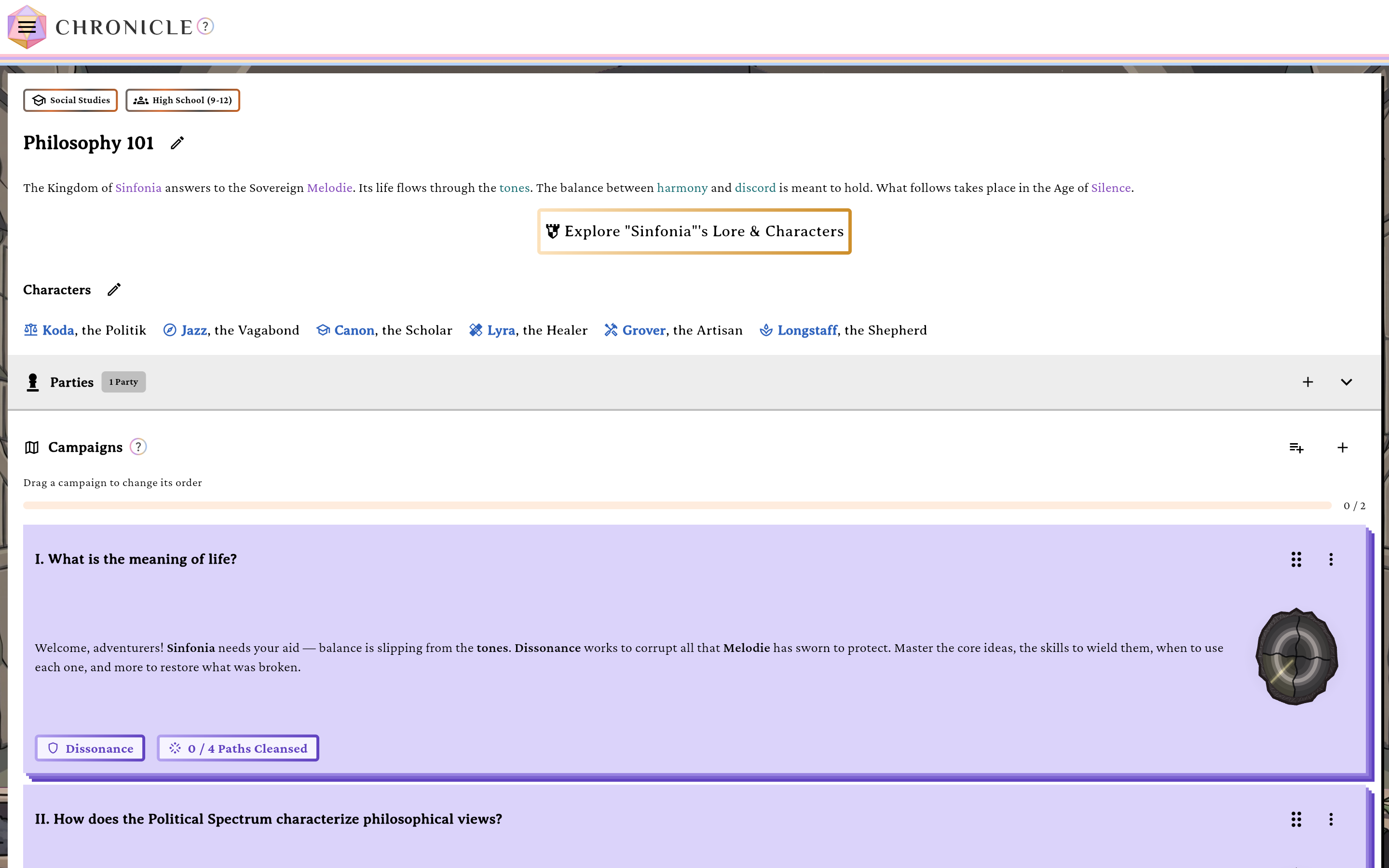
The course opens at a single screen that both you and your students reach. It is a main destination, not something you drill down into. There is no separate “course builder”: the list of units is the course.
What everyone sees:
- Identity: the course’s name, subject, and audience.
- Lore: the realm, the cosmic Force, and the cast of eight companions. See Set up & Use Lore.
- Campaigns: the ordered units, each the way into its Paths and Nodes.
What only an editor sees:
- Parties: create, edit, and delete the course’s cohorts.
- Dungeons: assemble and share review challenges. See Dungeons.
- Sources: the library the AI Wizard reads when you generate content.
Why Parties are editor-only
A Party’s join code is a credential. Showing the parties section to everyone who can read the course would hand every enrolled student the code for every other cohort in it. Dungeons and Sources are withheld for the same reason: each is a management surface, not course content.
Lore deliberately crosses that line
Lore is the one editor-adjacent thing students do see. It discloses nothing (it is the setting, not a credential), and a student who cannot name the realm their class is set in is missing the point of the course. Only the edit affordance is withheld.
One join code for the whole course
A Party enrols in the course, not in a unit. So one 6-character code covers every Campaign in the Chronicle, and a student who joins lands on the course page with access to every unit in it. You do not re-issue a code per unit.
See Parties & inviting players for running a cohort, and Join a Party for the student side.
Houses are optional
A Chronicle can live outside every House. A House only controls who else may edit your courses. It is never required, never a container, and never created for you. See Create a House & invite collaborators.