Gamemasters · Dungeons
Dungeons — Shareable Review Challenges
Assemble a boss fight from your course's published questions and share it as a link. No account needed to play, full combat, and a leaderboard you can narrow to one cohort.
Verified against app build 2f427ecbd · 2026-09-24
A Dungeon is a review challenge you assemble from the questions already published in your course, then share as a link. Think of it as Kahoot for the reviews that don’t warrant the full LMS — a Friday recap, a pre-test warm-up, or something to hand a substitute.
Anyone with the link can play it, with no account and no enrolment.
It plays like a Rift
A Dungeon runs on the same engine as a graded quiz: the avatar attacks, the mob takes damage and dies, the dice ceremony plays, and the HUD bands and the three-heart HP behave exactly as they do in a Rift.
Where a Dungeon lives
A Dungeon is filed under exactly one Chronicle (course) — never under a unit, a path, or a single lesson. It is defined by spanning lessons, so anchoring it any deeper would contradict what it is. A review of one lesson is simply that lesson’s own question set.
Deleting the course takes its Dungeons
A Dungeon is assembled from questions that live in the Nodes of that course, so a Dungeon surviving its course would be an empty arena with a working share code. Deleting a course therefore takes its Dungeons with it. Because that cascade is silent, the app refuses to delete or move the course’s last unit rather than let you lose share codes, leaderboards, and attempt history as a side effect.
Build one
Open Dungeons on the course
The Dungeons section sits on your course hub, below the units. Like Parties and Sources it is editor-only.
Pick the questions
Choose from the questions published across the course’s lessons. A Dungeon must have at least one question — the fight is the Dungeon, so an empty question set is rejected rather than saved as a draft.
Write the story, inline
Two sentences are composed mad-libs style, the same way Lore is: tap the highlighted words to choose the boss you will fight and the place you will fight it in. Every blank ships with a sensible default, so the Dungeon is already playable the moment you open the form.
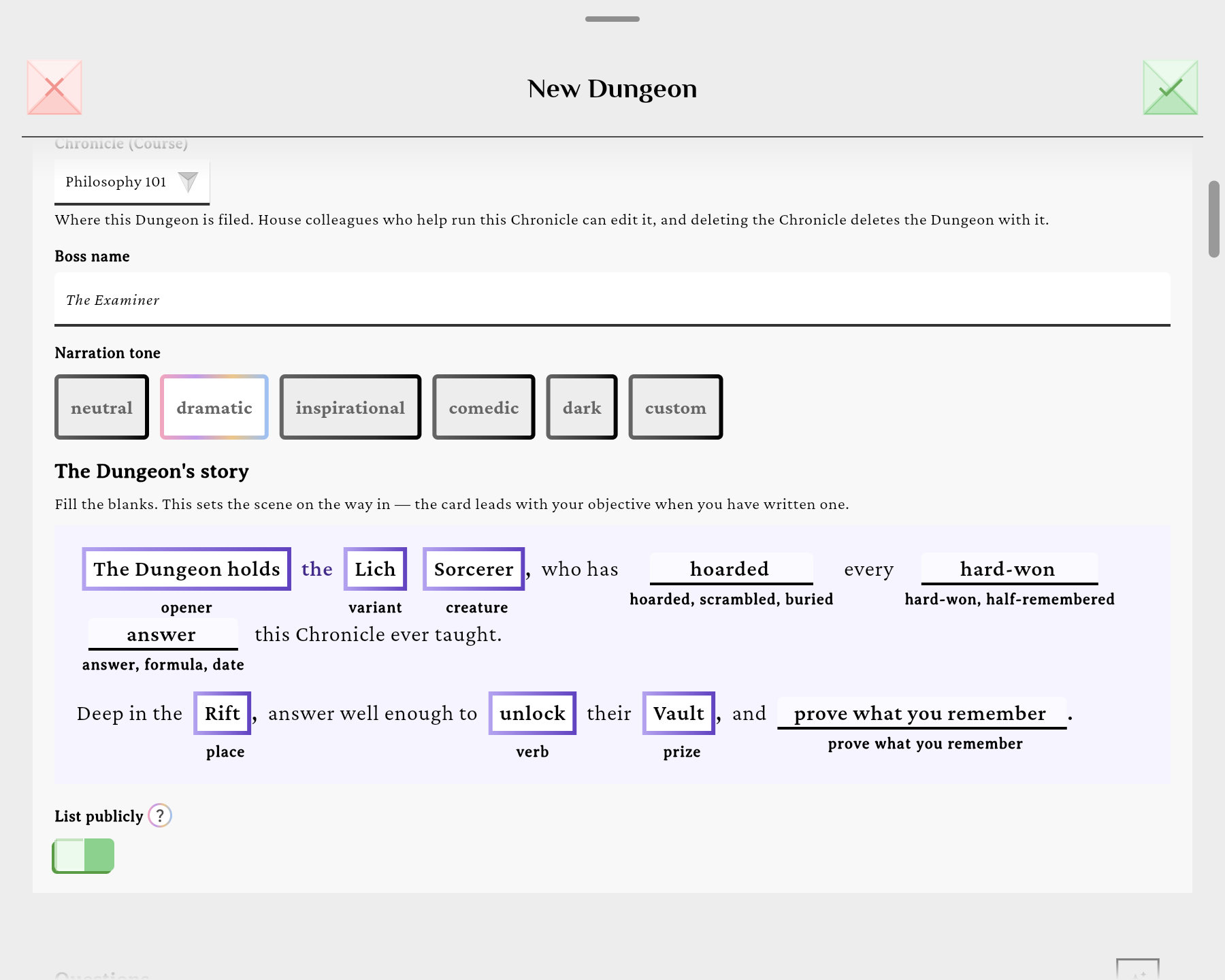
Boss and arena are picked from inside the sentence.verified @ 2f427ecbd Optionally add a briefing
A Dungeon can carry a Briefing: Motes borrowed from your course’s published lessons, shown as expandable panels under Before you go in on the start card. Search the course’s Motes by title and tick the ones you want, then set On the start card to:
- Hidden: players never see the Briefing.
- Shown: available to read, but the fight is never held on it.
- Must be opened: the fight button unlocks once every Mote has been opened.
Nothing in a briefing is recorded — see below.
Share the link
Saving mints a share code. Anyone holding the resulting link can play.
A briefing is read on the way in, never recorded
Opening a briefing panel records nothing: no Mote completion, no reflection answer, no lesson progress, and no Shards. A borrowed Mote belongs to a course the player may not be enrolled in, so only the fight counts.
What a player gets
- No account required. The link is enough.
- A fixed difficulty. A Dungeon always plays at its own set difficulty — there is no selector — though the resolved value is shown with the other stats.
- No effect on course standing. A Dungeon run writes no graded record, earns no renown, and does not touch the party or campaign leaderboards.
Signing in mid-session replays rather than uploads
An anonymous run is scored on the player’s own device and never sent to RPGLMS. A guest who signs in to keep a result fights the boss again, and that signed-in run is the one that counts.
The leaderboard
A Dungeon keeps its own leaderboard, which you can view globally — across everyone who has ever played the link — or narrowed to a single Party, so you can see just your own cohort without the public scores on top of it.
Only signed-in runs appear on the leaderboard; anonymous runs stay on the player’s device.